Get in touch


Send a Courier from India to 180+ Countries
Get a Free Quote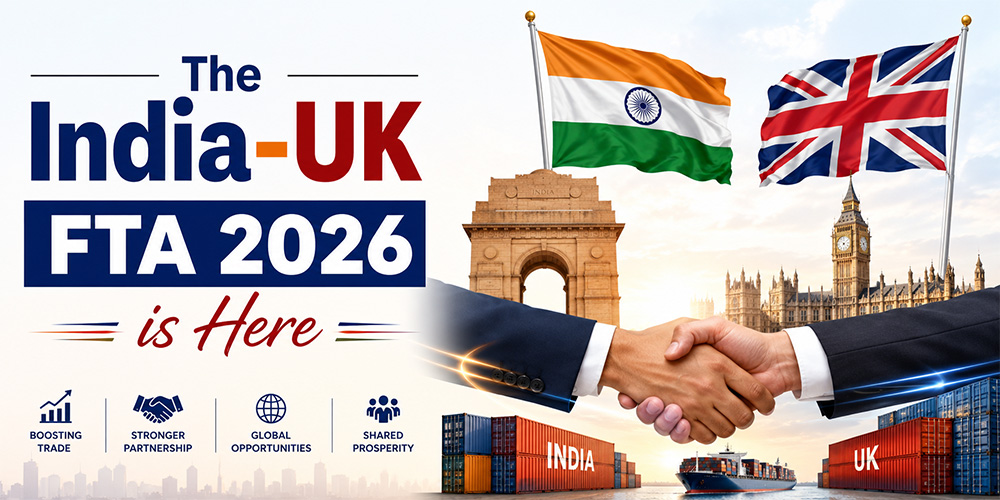
The India-UK Free Trade Agreement (FTA) officially comes into force on July 15 2026. It is by a big margin the most comprehensive deal India has ever signed. It is officially known as the Comprehensive Economic and Trade Agreement (CETA). It includes 30 chapters containing economic frameworks that will remove trade barriers between the two nations and aims to push bilateral trade to $100 billion by 2030.
The India–UK trade deal will fundamentally shift how goods move between these two markets. From retailers sourcing textiles to manufacturers shipping complex auto components, or even individuals sending parcels for personal use, this deal affects everyone.
But what exactly changes, and what do these changes mean for various stakeholders? We have surfed through the fine print and have provided a breakdown of the India UK free trade agreement so that you can grasp it with ease!
First, let's look at this India UK trade deal through the lens of numbers. As per the UK government's impact assessment , the deal will boost UK GDP by £4.8 billion and real wages by £2.2 billion in the long run. .
For India, the benefits are mostly in the form of becoming more competitive with the neighbouring nations. For example, before this deal, when compared with Bangladesh and Pakistan, in sectors like textiles India faced a 12% tariff disadvantage. This deal will bring parity for India.
The biggest win is the trade volume. It is expected that the volume will see a big increase and in fact some estimates suggest that logistics providers will have double-digit shipment growth over the next 12 to 18 months.
India exported $13.4 billion worth of goods to the UK in FY25, while imports stood at $11.7 billion. Now that the deal is in force, these numbers are expected to jump sharply.
The biggest outcome from this deal is the reduction in tariffs. And we are looking at some massive reductions. The UK is scrapping duties on 99% of Indian exports and on the other hand, India is reducing tariffs on 90% of UK imports.
| Product | Duty before | Duty after | Notes |
|---|---|---|---|
| Indian textiles & garments (into UK) | Up to 12% | 0% | Immediate |
| Indian seafood, grapes, mangoes (into UK) | Various | 0% | Duty-free access |
| UK Scotch whisky (into India) | 150% | 75% → 40% | 40% phased over 10 years |
| UK auto components (into India) | Up to 100% | 10% | Under quota |
| UK machinery & tools (into India) | — | −15% cut | Immediate |
What this means for UK retailers and sourcing professionals:
For Importers and Consumers in India:
However, lower tariffs don't automatically translate into cheaper products or a seamless flow of goods. There are a few issues to sort out now.
Carbon Border Tax (CBAM): Even if tariffs fall to zero, the UK's proposed carbon tax could increase the effective cost for Indian exports in certain sectors, which would offset the gains from the slashing of tariffs.
Utilisation Rates: Historically, small businesses underutilize FTAs. Only 20-30% of eligible exports currently claim FTA benefits because they aren't aware of the rules. An Indian garment exporter needs to actively inform the UK buyer that duty has fallen to zero and redo the negotiations.
Documentation Complexity: To claim these new preferential tariffs, businesses need robust certification and proof of origin. This requires perfect documentation.
This is where rubber meets road. As a logistics provider, our job is to bridge the gap between the "deal" and the "delivery."
We need to understand that the FTA does not only impact the cost of goods; it also impacts the flow of goods.
Increased Volume Across the Board:
There is already significant preparation in the market. Major UK high-street retailers are conducting joint forward planning with their Indian suppliers. Earlier, this practice was only reserved for US clients.
Expect a sharp rise in commercial freight, e-commerce parcels and personal shipments as there is a 1.9 million-strong UK-Indian diaspora .
The Shift Beyond Tier 1 Cities:
Demand is rising beyond Delhi and Mumbai. Emerging hubs like Pune, Ahmedabad, Jaipur, and Coimbatore are becoming important shipment destinations . So trade volume will increase and it will increase from a wide range of places.
Technology and Documentation hold the Key:
To get your goods through customs quickly using the new tariff structure, your paperwork needs to be highly accurate and updated. We need to remember that lower tariffs can open the door, but they do not move the goods. So these formalities become crucial.
End-to-End Accountability:
The new regulations are complex, hence having a logistics partner with local expertise on both sides of the border is paramount.
The India–UK FTA brings with it a historic opportunity. It makes India a stronger sourcing market and a lucrative export destination. However, the logistics side demands precision.
The tariff savings from the India-UK CETA can be enjoyed only when the paperwork is right, the shipment is fast, and the customs clearance is smooth. And to make all that happen, Atlantic International Express is always eager to join hands with you.
Looking to move goods between the UK and India? Contact us now to discuss how we can help you navigate the new tariff landscape and build a supply chain that is resilient, cost-effective, and ready for the future.
While the agreement does not directly reduce freight charges, it can lower the overall cost of international trade by reducing customs duties, streamlining border procedures, and minimizing delays.
Yes. One of the key objectives of the agreement is to simplify customs procedures and improve trade facilitation. Businesses can expect faster documentation processing, greater transparency, and smoother cross-border movement of goods.
India is expected to expand exports of products such as textiles, garments, leather goods, pharmaceuticals, engineering products, automotive components, agricultural products, seafood, spices, chemicals, and gems and jewellery.
Businesses should review their export strategy, understand applicable tariff benefits, ensure compliance with customs regulations, and work with experienced logistics partners.
An experienced logistics partner such as Atlantic International Express helps businesses manage international shipping, customs documentation, freight forwarding, warehousing, cargo insurance, and regulatory compliance.
Although the agreement simplifies trade, businesses may still face challenges such as regulatory compliance, product certification requirements, documentation accuracy, changing trade policies, and supply chain disruptions.
The agreement encourages smoother cross-border trade by reducing trade barriers, improving customs efficiency, and increasing collaboration between businesses in both countries.
A professional logistics company supports businesses with international freight forwarding, customs clearance, documentation, warehousing, cargo consolidation, multimodal transportation, and end-to-end supply chain management. With expert guidance and efficient logistics planning, businesses can take full advantage of the opportunities created by the India–UK Free Trade Agreement.