Get in touch


Send a Courier from India to 180+ Countries
Get a Free Quote
You have packed the box. You've double-checked the address. You're ready to ship.
Then the courier quote shows up, and it’s double what you expected.
Suddenly, questions begin to race. Did I get the weight wrong? Is the box too big? Why does shipping to the USA cost more this week than last month? Is there a hidden fee that was missed?
This is something businesses, online sellers, and even first-time international shippers face every single day. International shipping costs don’t rise randomly; they follow clear rules. Weight, size, destination, shipping mode, and customs all have their say. An international courier cost calculator helps you see those numbers as clear as crystal before you ship out, so that there are no last-minute surprises.
Shipping costs rarely stay the same. They can change quickly, sometimes overnight.
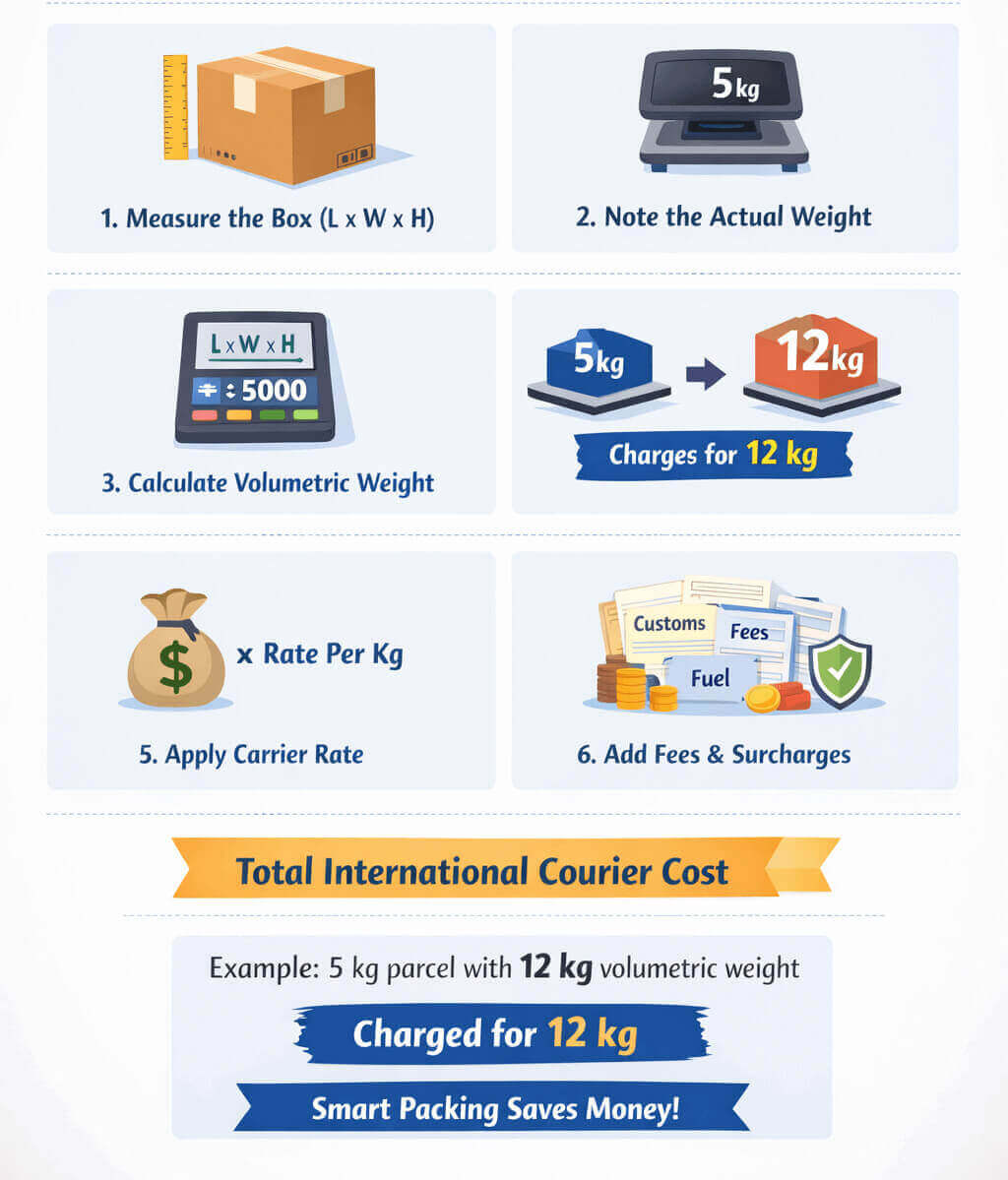
One big reason is weight and volume. Carriers don’t charge only by actual weight. They compare it with dimensional (volumetric) weight. Whichever is higher becomes the billable weight. That’s why large, lightweight parcels often cost more than expected.
The shipping mode also affects pricing. Air shipping is the fastest option, but it comes at a higher cost. Sea shipping takes longer, yet it works well for bulk cargo and lowers the international shipping cost per kg. Land transport usually falls somewhere in between.
Then come the additions. Customs duties, port handling charges, fuel surcharges, and last-mile delivery fees can quietly raise the final international courier cost. Skipping these factors leads to pricing surprises later.
A reliable international courier cost calculator brings everything into one place. No guesswork. No hidden math.
It asks for package weight and box dimensions. It catches the origin and destination countries. It also lets you add insurance, delivery speed, and extra services when needed. The best calculators go a step ahead. They pull live carrier rates, factor in taxes and surcharges, and show the total international shipping cost upfront. That means faster decisions and fewer surprises later.
Interactive tip : Try different shipping options.
Seeing these can often reveal lower courier charges and smarter shipping choices.
Not all routes are priced the same. Some shipping lanes are busier. High demand pushes rates up. Certain ports add extra handling and documentation fees. Others take longer to clear. That affects cost. Shipping from India to the USA or UK usually costs more than sending parcels to nearby countries. Distance, customs rules, and delivery expectations all play a role.
Additionally, prices can vary by season. Peak hours, fuel charges, and carrier capacity can increase international courier charges overnight. Therefore, it is essential to research country-specific surcharges before booking.
Pro tip :
The price difference appears instantly, helping you balance speed and budget smartly.
A quick review of past shipments usually reveals easy savings. Spot the gaps. Fix them. Lower your international courier cost.
Pro tip: Show customers an itemized shipping cost. Transparency builds trust and reduces disputes before delivery.
International shipping doesn’t have to be uncertain or expensive. When you understand how courier pricing works, from weight and volume to routes and surcharges, you stay in control. An accurate cost calculator gives you clarity before shipping, not after.
Atlantic International Express makes it easy. With transparent pricing, global coverage, and expert support, Atlantic makes international courier planning simple and predictable. Whether you’re sending documents, parcels, or commercial shipments, you get accurate estimates, dependable delivery, and the confidence that every shipment is handled right.
Plan better. Ship smarter. Choose Atlantic International Express for international courier services you can trust. Get your quote now.
International courier cost per kg depends on the weight of the cargo and the class of service. It is more expensive to ship by air than by sea.
Use actual or volumetric weight (whichever is higher), multiply by the carrier rate, then add taxes and surcharges.
Because volumetric weight is package size-oriented. Normally, couriers charge either an actual or a volumetric weight, whichever is higher.
That would depend on the destination, weight, and service type. Economy or sea services usually cost less.
Costs rise due to fuel charges, customs fees, distance, and higher handling for international deliveries.