
Send a Courier from India to 180+ Countries
Get a Free Quote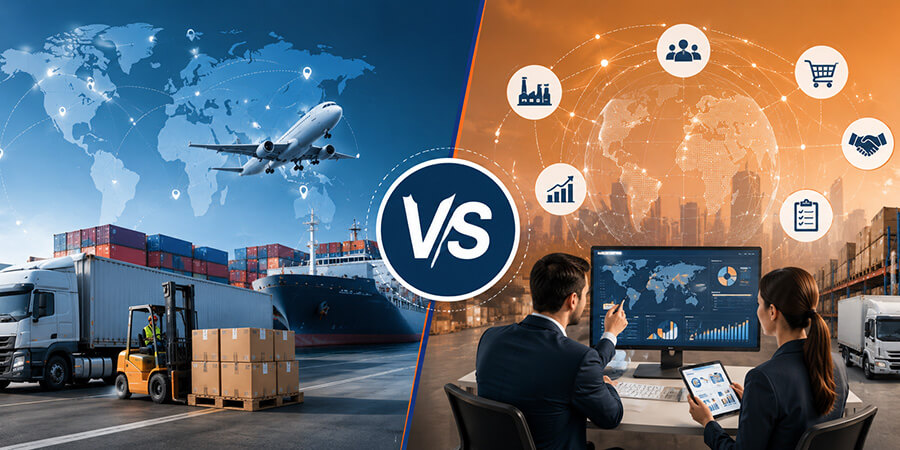
“This guide breaks down the key differences between logistics and supply chain management. It looks at how each function supports the movement of goods, sharpens operational efficiency, cuts costs, and improves customer satisfaction, and why logistics ends up being such a vital part of the supply chain, tying both together in successful international business operations.”
The terms logistics and supply chain management are used a lot interchangeably, but they are not quite the same thing. Knowing the difference between logistics and supply chain management helps you make smarter calls on costs, on timing, on where things actually go wrong when a shipment runs late.
Supply chain management is the bigger picture, the entire journey a product takes. Sourcing the raw materials, manufacturing, holding inventory, distributing it, and finally getting it into the customer's hands. Logistics is a part of supply chain. It is all about storage, transportation, and smooth movement of goods from one stage to the other.
Whether you are exporting, manufacturing, running a retail business, or selling online, understanding logistics vs supply chain management helps you build something faster and more reliable. We handle that for you at Atlantic International Express, simplifying international logistics with shipping solutions that move goods across borders with seamless confidence.
Logistics is the process of planning, controlling, and managing the flow and storage of goods from their origin to their destination. The goal, at its core, is simple: right place, right time, right condition, lowest cost possible.
Transportation gets most of the attention, but it's only part of the picture. Logistics also means coordinating storage, inventory movement, packaging, route planning, documentation, and the final delivery itself. Every one of these pieces has to be managed carefully, or the whole flow stalls somewhere along the way.
A logistics operation includes:
It doesn't matter how big or small a business is, logistics still matters just as much. Do it well, and delays go down. Transportation costs stop climbing. Deliveries actually show up on schedule, and customers stay loyal. Do it poorly, though, and deadlines get missed, costs pile up, and the whole operation starts running less smoothly than it should.
Comparing logistics management vs supply chain management, logistics is the part you can actually see happening: Goods moving, sitting in storage, arriving where they need to be on time. Technology has changed how well this can be managed. A shipment can be tracked in real time. A warehouse management system keeps stock accurate instead of guessed at. Route optimization trims delivery times. All of it adds up to more accurate deliveries and customers who trust the business a little more.
Supply chain management, SCM for short, is what ties everything together: Planning, coordinating, and managing the full flow of goods, services, information, and money, starting at raw materials and ending when the finished product lands with the customer. Logistics focuses more narrowly on moving goods around. SCM takes a wider view, connecting every stage of the business so efficiency and customer satisfaction actually improve.
A typical supply chain includes:
Supply chain management exists to make every one of those stages work together instead of separately. When suppliers, manufacturers, distributors, and logistics partners actually collaborate, costs come down. Risk gets easier to manage. Inventory stops sitting around unused or running out at the wrong time. And when customer demand shifts, the business can actually keep up with it.
The two terms are related, but their scope and purpose differ in ways that actually matter. Understanding logistics vs supply chain, or supply chain management vs logistics, helps businesses figure out which strategies will genuinely improve their operations.
| Logistics | Supply Chain Management |
|---|---|
| Focuses on movement and storage of goods | Focuses on End-to-end management of products |
| Deals in transportation, warehousing, and delivery | Deals in procurement, production, inventory, logistics, and distribution |
| Aims to deliver goods efficiently | Optimizes the entire supply chain |
| It is Operational | It is Strategic and operational |
| Priority is speed, accuracy, and cost-effective delivery | Priority is coordination, planning, and overall business performance |
A simple example makes the logistics and supply chain difference easier to grasp. Take a furniture manufacturer. Supply chain management touches almost every part of that business, purchasing the timber, managing suppliers, running production, tracking inventory, and fulfilling customer orders. Logistics steps in later, once the furniture is actually ready to move, taking care of storage, transportation, and getting it delivered.
When it comes to logistics management vs supply chain management is really a question of scope. Logistics handles the movement of goods. Supply chain management coordinates the entire journey around it, making sure every process actually works together.
Yes, logistics is part of supply chain management, and it ranks among the most important functions in the entire process.
Products need logistics to actually get from suppliers to manufacturers, then to warehouses, retailers, and finally customers; none of that happens on its own. Supply chain management, though, covers a lot more ground than transportation. Supplier relationships, procurement, production planning, inventory control, demand forecasting, customer service- all of it sits inside that scope.
An ecosystem is probably the best way to picture the supply chain: dozens of moving parts, all depending on each other to function. Logistics is the piece that keeps products actually moving through that system, getting the right goods to the right place at the right time.
This is why logistics and supply chain management get mentioned in the same breath so often. One handles the operational work of moving goods, the other keeps every stage, sourcing through final delivery, connected and running efficiently.
Businesses working in international trade feel this pairing directly. Good logistics and efficient supply chain management generally means lower costs, faster delivery, tighter inventory control and loyal customers.
Whether logistics or supply chain management is more important to your business depends on what you’re trying to solve. Moving goods from A to B, storing them, and getting them delivered efficiently is the realm of logistics. Managing suppliers, production, inventory, distribution, and customer demand, that's where supply chain management takes over with a wider strategy.
Most growing businesses end up needing both rather than picking a side. Supply chain management builds the plan; logistics is what actually carries it out. Between the two, costs come down, operations run better, and customers walk away happier.
International shipping adds another reason logistics matters on its own. Efficient transportation, accurate documentation, and deliveries that show up on time keep products moving to customers without the delays that tend to pile up otherwise.
International shipping only works when the logistics behind it hold up, and that is the piece Atlantic International Express focuses on. Businesses, exporters, eCommerce sellers, individuals moving personal shipments- we work with all of them, building courier and logistics solutions around getting shipments where they need to go worldwide.
Our services include:
Transportation that runs on schedule, paired with support that actually knows the shipping process, is what keeps international logistics simple for our customers. The result is shipments that arrive safely and on time, without the guesswork.
These terms get used interchangeably often enough, but logistics and supply chain management are not the same thing. Logistics handles the movement and storage of goods, keeping it efficient. Supply chain management covers the bigger journey, sourcing, production, distribution, right through to the customer.
Knowing the difference helps businesses make smarter operational decisions, keep costs under control, and run more efficiently overall. Whether you are expanding into new markets or managing shipments internationally, Atlantic International Express offers reliable logistics solutions to keep your business moving with confidence.
Technically, supply chain management comes first; it is the plan for how products move. Logistics then puts that plan into action, storing and moving goods the way the plan actually calls for.
Honestly, it is an easy mix-up. Both are about getting products from one place to another. But logistics stays narrow, transportation and storage, while supply chain management pulls in sourcing, production, inventory, logistics, and delivery too.
Small businesses benefit here too, more than people usually assume. Tighter inventory control, lower costs, better supplier relationships, faster order fulfillment- all possible from just applying basic supply chain management practices.
No. Logistics also includes warehousing, inventory movement, packaging, order fulfillment, route planning, and returns management in addition to transportation.
Technologies such as GPS tracking, warehouse management systems, inventory software, automation, and data analytics help businesses improve visibility, accuracy, and operational efficiency.
Retail, eCommerce, manufacturing, healthcare, automotive, pharmaceuticals, food and beverage, and international trade all depend on efficient logistics and supply chain operations.
International shipping is part of the logistics function within the supply chain. It ensures goods are transported safely between countries and delivered to customers or distribution centers.
Common challenges include transportation delays, rising freight costs, inventory shortages, customs regulations, demand fluctuations, and last-mile delivery issues.
A few moves tend to help most: tightening delivery routes, tracking shipments in real time, working with logistics partners you trust, automating parts of the warehouse, keeping inventory records accurate instead of estimated.
The right partner changes everything: deliveries on time, goods handled securely, full visibility into shipments, support through customs, and a shipping process that just works, freeing businesses to focus on growing instead.