
Send a Courier from India to 180+ Countries
Get a Free Quote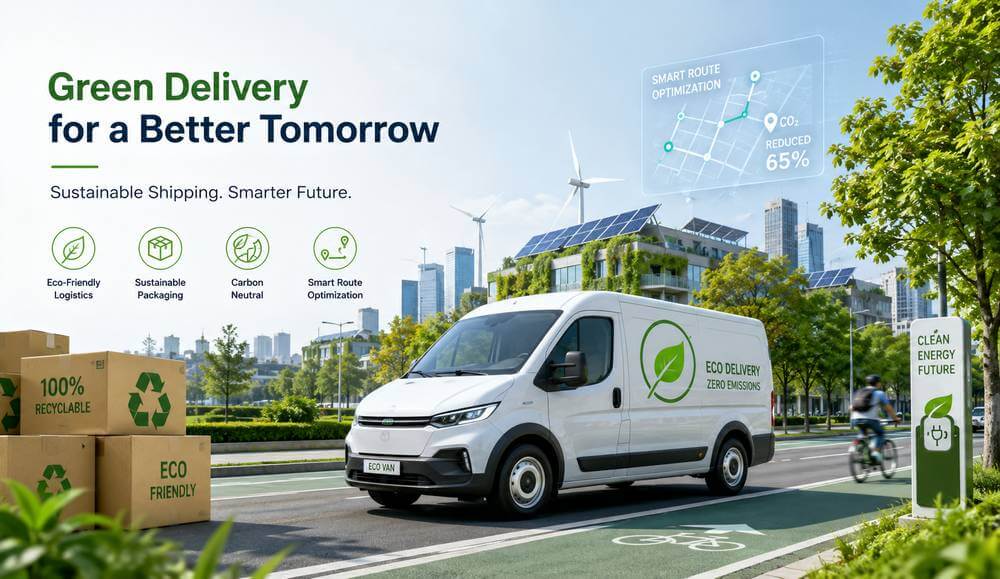
If you really think about it, most of us never cared how a package got to us. It showed up, we opened it, and that was the end of the story. The process behind it stayed invisible.
Lately, though, that has started to change a little. Not in a loud or obvious way, but enough that you begin to notice it if you pay attention. There is a growing curiosity around how things move, how often they move, and what that actually means in the long run.
That is where ideas like sustainable courier services and green logistics slowly enter the conversation. Not as big announcements, but as small shifts in thinking.
No one was ignoring sustainability before. It just did not feel immediate.
There were other things that demanded attention. Late deliveries, rising costs, and increasing order volumes. Those were problems you had to deal with right away.
Environmental impact felt distant. Something important, but not something that would disrupt your day if you ignored it for a while. Then delivery volumes went up. And kept going up.
More online orders, more frequent shipping, more expectations around speed. All of that meant more vehicles moving constantly. More fuel is being used. More pressure on systems that were already running at full capacity. At that point, it became harder to pretend it was not a factor.
You often think about making a large shift towards being more sustainable; however, the majority of the total environmental impact comes from small improvements in your day-to-day operations.
A significant number of customers, for instance, experience the same benefits from fewer trips to visit suppliers or from improving coordination with suppliers, and through more efficient use of resources (e.g., food, transportation) as they do from larger changes.
While it may not seem that the above examples will have a big impact on sustainability individually, applying them consistently and relentlessly will help you achieve a sustainable system more rapidly through a consistent accumulation of benefits over time.
What is interesting is not just that sustainability is being discussed more. It is how casually it shows up now.
You will hear someone mention eco-friendly delivery in passing. Or green logistics, almost like it is a normal part of the conversation. It does not feel like a separate topic anymore. It sits alongside everything else.
And even when customers are not asking directly, there is a quiet awareness there. Businesses can feel it. That is usually enough to start adjusting things.
At one point, these felt like two different directions. Efficiency meant getting things done faster and cheaper. Sustainability meant slowing down and being careful. That is not really how it works anymore.
If you plan routes better, you save time. You also use less fuel. If you organise deliveries more efficiently, you reduce the number of trips. That lowers costs and emissions at the same time.
So, without trying too hard, improvements in operations start supporting sustainable courier services.
It is rarely one big change that shifts things. It is a series of smaller ones. A slightly better route. A better delivery sequence. Avoiding unnecessary back-and-forth movement.
None of these feels like a major change when you look at them individually. But over time, they start to stack up.
That is usually how green logistics actually takes shape. Not through one decision, but through many small ones that keep getting repeated.
Electric delivery vans catch your eye! Not only do they show your commitment to going green with your package and your company's values, but they are also an indicator of the new way to deliver packages with minimal environmental impact. However, electric delivery vehicles are just one part of the overall picture.
You can change your vehicle to be electric, but if the routes you run are not efficient or your operations are disorganized, the overall sustainability impact is limited compared to what it could be.
This is why, when it comes to sustainability in the courier business, it is not just about changing just one thing, but rather about how all the pieces fit together and work together towards the big picture.
Many of the advancements made to green logistics have been brought about by systems that operate quietly behind the scenes; route optimisation, tracking instruments, and data analytics all contribute toward reducing needless movements.
These alterations are not always apparent; rather, they increase the overall efficiency of operational processes while providing practical methodology for conducting environmentally friendly deliveries.
Electric delivery vans are a great way to show your commitment to being green and to how you handle packages with environmentally friendly practices as a business.
Additionally, they provide you with a fresh alternative for delivering packages to your customers while having the least impact on the environment. However, transitioning to electric delivery trucks is just one small piece of the larger puzzle.
Changing to electric vehicles is great; however, if you have inefficient routes or disorganized operations, your overall sustainability will be limited compared to the potential it has.
In summary, when it comes to being sustainable in the courier industry, it's not simply about changing one element of your operation; instead, it's about how every component fits together to create a cohesive whole and work together toward achieving a common goal.
Most people think of delivery as the main part of logistics. But everything that happens before that is just as important.
How goods are stored, how they are moved within a warehouse, and how efficiently space is used. All of these affect the overall system.
Better organisation inside warehouses reduces unnecessary movement. That, in its own way, supports green logistics.
If you are expecting a sudden shift, it might feel like nothing is happening. But that is not really how this works.
Most companies make changes gradually. They test what works, adjust where needed, and build on small improvements. It is not fast, but it is steady. And that tends to last longer.
Shipping companies are only part of the system that makes up delivery systems for companies that deliver items. Companies that deliver items are often impacted by many different factors, including how often they deliver, how they package items for shipment, and how they combine items for delivery. All of these factors have a significant impact on delivery effectiveness.
By purchasing multiple small shipments and combining them into one large shipment, a company can reduce the number of deliveries it makes. This will create more environmentally-friendly shipping without requiring large-scale modifications to the shipping method.
Customers may not always ask about sustainability directly. But there is a growing awareness. People notice patterns. They notice waste. They notice when something feels excessive. That awareness does not always turn into questions, but it does influence choices over time. And that is usually enough to push change forward.
Sustainability at Atlantic is considered an integrated aspect of the evolution of our operations rather than being viewed as an additional aim of our business.
This transformation includes improved route planning, less needless travel, and better resource management.
There are no single large changes that have occurred since the beginning of this transformation; it has instead been achieved through consistent efforts over time.
It is becoming clear that sustainability is not going away. It is slowly becoming part of what people expect from courier services. Not as an extra feature, but as something built into how things work.
You do not need to overcomplicate it. Sustainability in courier services often comes down to doing things a little better each time. Less waste. Better planning. Smarter movement. Over time, that is what makes the difference.
As sustainability expectations keep increasing, collaborating with a courier company that is knowledgeable about both effective and ethical practices can benefit you.
The Atlantic Strategy focuses on operational improvement in incremental ways, allowing businesses to modify their logistics to be more sustainable without having an adverse effect on dependability.
They focus on reducing environmental impact through better planning and efficiency
It reduces waste and fuel use through smarter operations
They are increasing gradually, especially in cities
Sometimes initially, but it becomes efficient over time
It helps reduce environmental impact and supports long-term operations