
Send a Courier from India to 180+ Countries
Get a Free Quote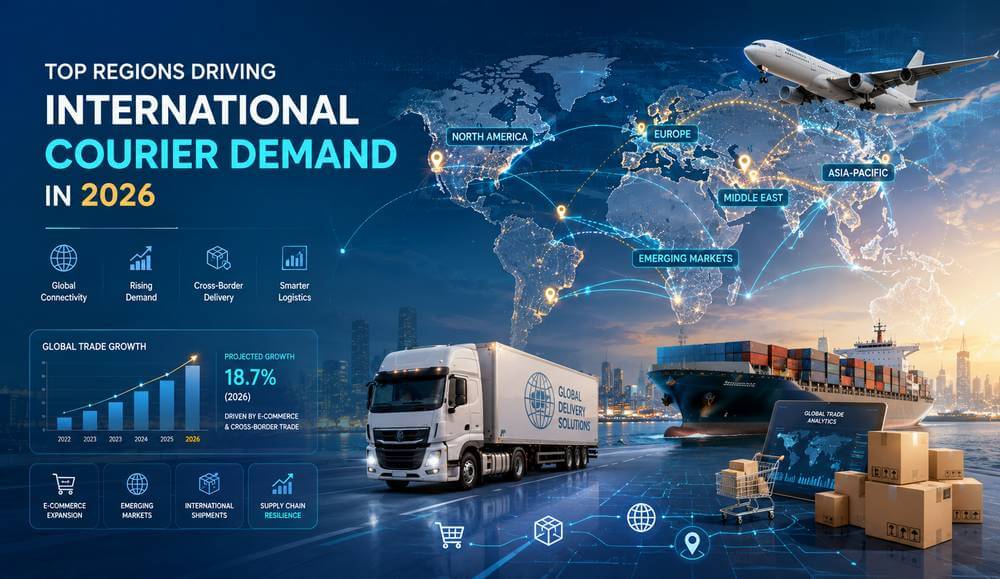
If you track international courier movement for a while, a pattern starts showing up. Demand doesn't rise everywhere at the same pace. Some regions move faster, some just stay consistent, and a few change direction depending on what's happening around them.
It's not only about how big a country is. Or how many people live there?
It's more about activity. Who is buying, who is selling, and how often goods are crossing borders. Courier demand follows that activity almost quietly.
When businesses start selling outside their local markets, shipments increase. When buying habits shift, deliveries adjust without much notice.
So instead of looking at the whole world together, it makes more sense to slow down and look at specific regions. That's where the changes actually become clear.
Asia doesn't move in one straight line when it comes to courier demand. It moves in multiple directions at once.
Countries like India, Vietnam, and Indonesia are sending more shipments outward, especially from smaller businesses trying to reach global buyers. At the same time, there's an increase in inbound deliveries because people are ordering more from outside.
So it's not just export-driven. It's both sides working together. Manufacturing plays a role, but so does e-commerce. That combination keeps movement steady rather than seasonal. You don't see sharp spikes as often. Instead, you see continuous activity that doesn't really slow down.
North America doesn't always show fast growth, but it rarely drops in demand either.
There's a kind of consistency there that comes from established systems. E-commerce is already strong, and cross-border shipping happens regularly without major disruption. Businesses depend on reliable delivery, especially for time-sensitive shipments. That keeps volumes stable.
It's not dramatic growth. But it's a dependable movement. And that matters just as much when you look at global courier networks. Because steady regions often support the rest of the system without drawing too much attention.
Europe operates a bit differently. A lot of its shipping happens within the region, but international demand is still present in a steady way. Trade flows in and out without sudden changes. Regulations can slow things slightly, but they also create predictability. That predictability matters.
It means businesses know what to expect. So instead of sharp growth, you see consistent flow. It doesn't stand out immediately, but over time, it becomes clear that Europe maintains its role through stability rather than speed.
The Middle East is not just growing its own demand. It's connecting other regions as well. Because of where it sits, shipments often pass through it while moving between Asia, Europe, and Africa. That creates a different kind of activity. Not just imports or exports, but transit movement too.
At the same time, e-commerce is growing locally, especially in cities. Infrastructure improvements are helping things move faster. So the region ends up doing two things at once. Supporting global routes and building its own demand alongside that.
Africa doesn't show explosive growth, but it is moving upward in a noticeable way. More people are coming online. More businesses are testing cross-border sales.
That leads to more shipments, even if the numbers are still developing. There are still challenges, especially around transport and delivery systems.
But those are improving, step by step. So the growth feels gradual, not sudden. And that kind of steady increase often becomes more important over time than quick spikes.
Southeast Asia is one of those regions where things are quietly building. Countries like Thailand and Malaysia are seeing more cross-border movement, both in terms of exports and imports. Small businesses are shipping internationally more often. Consumers are ordering from abroad more frequently.
It doesn't feel like a sudden jump. But the activity keeps increasing without dropping back. That's what makes it noticeable. It's not one big change. It's many small ones happening consistently.
China still plays a major role in international courier demand, even as things shift globally. A large number of shipments still originate from there, especially in manufacturing and bulk exports.
But there's also a slow redistribution happening. Some production is moving to other regions. That doesn't reduce demand. It spreads it.
So China remains central, but not as concentrated as before. It continues to influence global shipping patterns, just in a slightly more distributed way.
Latin America shows growth in a more gradual, uneven way.
Countries like Brazil and Mexico are seeing increased activity, especially in e-commerce and small business exports. At the same time, imports are rising as consumers explore global products.
Infrastructure challenges still affect consistency in some areas. But improvements are happening slowly. So while growth isn't rapid, it's steady enough to become part of the larger picture.
Courier demand follows trade more closely than anything else. When exports increase, shipments move outward. When imports rise, deliveries come in. Policies, agreements, and tariffs all influence these patterns.
Even small changes can shift demand from one region to another. So courier activity often reflects broader economic movement. It's not random. It's connected to how goods flow across borders at any given time.
The changing nature of e-commerce has resulted in an increase in the volume, frequency, and types of packages being delivered. Instead of numerous bulk shipments, there are now more frequent small shipments being moved.
There are also many more people buying goods from foreign suppliers without considering the potential long-term effects on their local and regional economy.
All of this movement creates an ever-increasing demand for courier services that specialize in small package deliveries, and as e-commerce continues to expand, so will the demand for courier services, which now experience increasing demand on a near-constant basis.
Speed is now expected, rather than considered as an additional benefit to the customer in relation to increasing shipments being shipped from A to B. The distance to the customer is no longer a factor in their overall expectation about the time to receive items.
As a result of this change in mindset, demand will increase in regions where a courier network is able to offer faster delivery services due to improved routing and increased handling time associated with deliveries. Therefore, the movement required to deliver an item will be based on the efficient transport of the item, not just the actual transportation route.
Infrastructure is often a deciding factor in determining the amount of demand cities and regions can physically support. This includes the operation of airports (runways); roadways (highways); and customs systems (the way the U.S. Customs & Border Protection operates).
Regions with strong infrastructure systems (i.e., little to no delay in shipment) tend to see an increase in their shipping volume, while regions with weak infrastructure systems (i.e., delays exist at times) also have demand for shipment but will have difficulties meeting that demand at times.
Thus, growth is related not only to a commodity (the need for shipment) but also to the ability of the region to reliably accommodate that commodity.*
More businesses are starting to sell beyond their local markets. Not always at a large scale. Sometimes it's just small, regular shipments. Courier services make that possible without requiring complex logistics setups. So even smaller companies can reach international customers.
That adds up over time. Instead of a few large exporters, you have many smaller ones contributing to demand. And that changes how shipment volumes grow across regions.
The demand for international couriers does not have a linear progression. The growth, signification, and adaptivity of this demand will vary, from one area to another. There will be also some areas, that will continue to grow, others will remain relatively stable, but are still important for the overall growth of the network.
The real picture of how these movements work will help explain where the future demand for the service is, and why they are going to be there.
International shipping today is less about volume alone and more about understanding where that volume is coming from. Different regions behave differently, and that affects how shipments should be planned and handled.
At Atlantic, the approach is built around observing these patterns and adjusting logistics accordingly. Whether it's managing cross border deliveries or keeping transit timelines consistent, the focus stays on keeping things simple and reliable.
If your business is expanding into international markets, having a clearer view of regional demand can make the process easier to manage.
Asia, North America, and Europe continue to contribute the most to courier demand. Other regions are growing steadily and adding to overall shipment volume.
Asia has strong export activity along with rising consumer demand. This creates continuous movement in both directions.
E-commerce increases cross-border buying, leading to more frequent shipments. This keeps courier demand consistently active.
Southeast Asia and Africa are showing gradual but steady growth. Their expanding markets are increasing shipment activity.
Infrastructure affects how smoothly shipments move across regions. Better systems support higher and more consistent demand.