Send a Courier from India to 180+ Countries
Get a Free Quote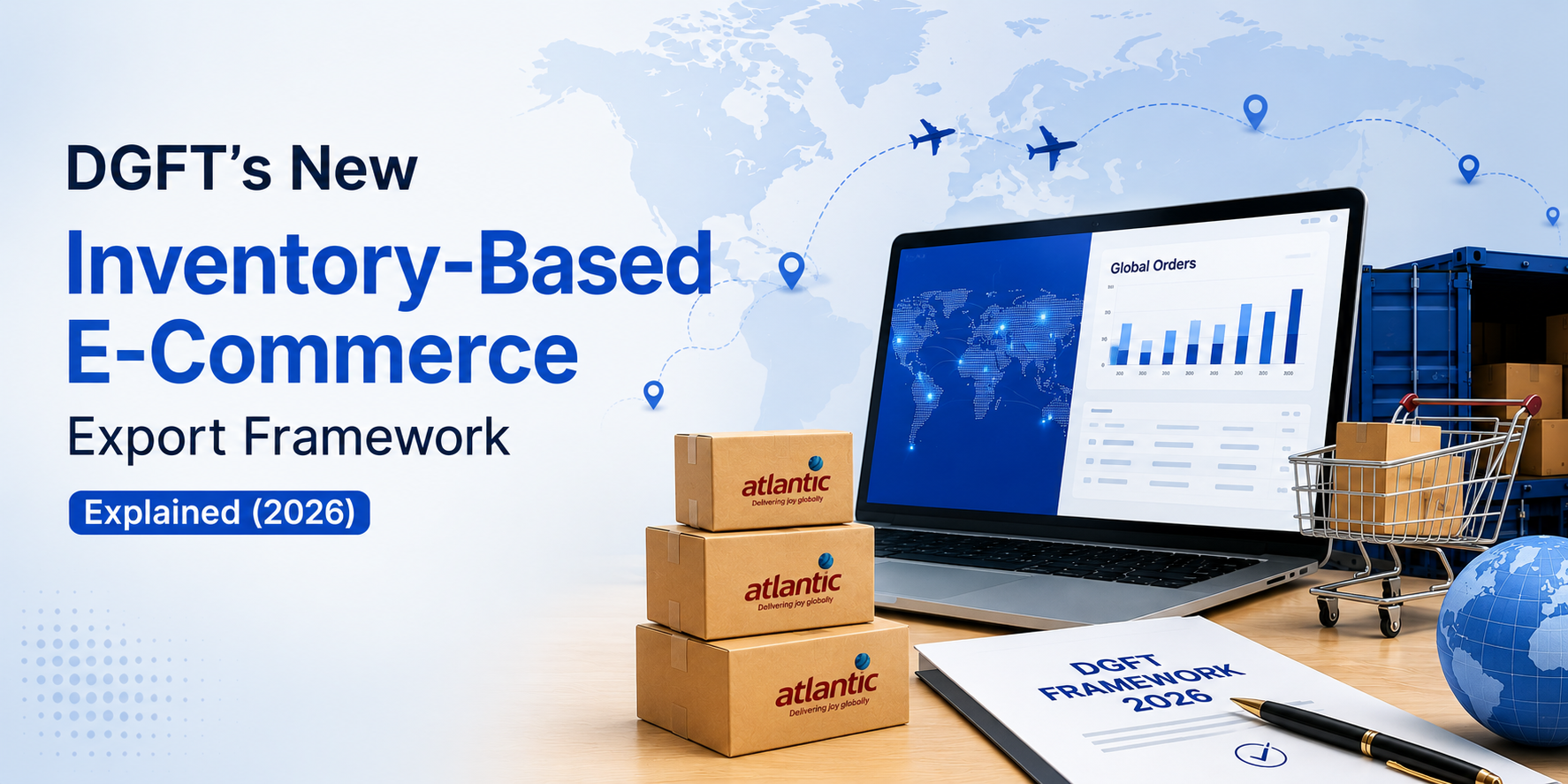
On August 5, 2026, the Directorate General of Foreign Trade (DGFT) rolled out what can be termed as the 'game-changing' change to India's cross-border e-commerce rules.
Selling to Canada? Learn how to manage e-commerce shipments from India to Canada.
If you are in the industry of selling Indian-made products online to customers in the USA, UK, Canada, Australia, UAE, or anywhere else in the world, then this is massive news for you. This new framework directly affects a lot of your core activities and hence is a huge deal. With this rule, how you can source, store, and ship your export inventory will change completely.
At Atlantic International Express, we work with exporters every day who move goods out of India to customers around the world. And in this blog, we have broken down this new ecommerce export handbook regulation so that you can grasp it completely. We now explain what it means, who it applies to, what documents you will need, and how it changes the shipping side of your business.
First, let's understand what DGFT is. DGFT stands for the Directorate General of Foreign Trade. It is the office of the Ministry of Commerce and Industry, Government of India. It takes care of implementing foreign trade policies and promoting India's exports and imports.
The DGFT has introduced the Inventory-based Cross-border E-Commerce Facilitation Framework, issued through Notification No. 27/2026-27 and Public Notice No. 25/2026-27.
What does this framework actually do for an e-commerce export handbook? This framework allows foreign-funded e-commerce companies to legally hold and manage inventory of Indian-manufactured goods. The next part of the rule is even more important. It says this allowance is granted only for the purpose of exporting them, not for selling within India.
Now, we should not look at this move in isolation. We have to understand it as a part of the bigger overhaul in rules which has been undertaken by the ministry in its DGFT handbook of procedures.
This move follows an earlier policy change by the Department for Promotion of Industry and Internal Trade (DPIIT). On July 23, 2026, the government permitted 100% foreign direct investment (FDI) in an inventory-based e-commerce model, specifically for exports.
So what we are seeing now through this August 5 DGFT notification is the operational rulebook that puts this policy into practice. This notification basically talks about covering registration, day-to-day operations, and compliance.
Also, when we say this new rule changes a lot of things, we have to understand the previous system. Only then can we understand the scope of the changes and their ripple effects.
So what was the system till now? Foreign-owned e-commerce companies operating in India faced strict limits on holding their own inventory. This rule was in place to protect domestic retail operating in the country.
This new framework provides a massive exception to this system of e-commerce export. Now, foreign-funded platforms can own and manage export-only stock of Indian goods by adhering to certain rules because there is massive growth of e-commerce exports from India.
In this new framework, a new entity called the Exporter-on-Record (EOR) takes centre stage. Now, what is an Exporter-on-Record (EOR)?
It is the official and designated legal entity responsible for ensuring that goods leaving a country comply with all local export laws, regulations, and customs requirements. They assume complete liability for the accuracy of export documentation, classification, and licensing.
Basically, what it means is that when goods are transported from one country to another, a lot of processes happen simultaneously. There are local export laws, there are customs requirements, and there are other aspects as well. So for a specific set of goods, the one umbrella entity that takes ownership of complying with all these rules and regulations is called the Exporter-on-Record (EOR).
So now under this new model, every transaction that happens runs through five stages:
The process starts when an overseas customer places an order. This happens when the customer buys a product through an eligible e-commerce platform.
At this stage, the EOR springs to action. They receive the confirmed order and purchase the goods from an Indian manufacturer or supplier, known as the Seller-on-Record (SOR).
The goods that are procured to fulfill the order of the overseas customer are marked as export inventory. They are categorically recorded in a digital tracking system and stored exclusively for export. It is important to note that these goods cannot be diverted to domestic sale.
The EOR now takes care of customs clearance, shipping, and all regulatory documentation.
The EOR pays the Indian supplier and passes on any eligible export incentives. If there are any reverse logistics processes to be carried out if goods are returned or rejected, then all this is done by the EOR.
The model explained above is a fundamentally different model from the marketplace-style e-commerce exports many businesses currently use. The reason is that the EOR now assumes legal and financial ownership of the inventory before it ever leaves India. So now we have a marketplace model vs. an inventory model being operated.
The framework of the DGFT Foreign Trade Policy is open to:
These include the companies that set up a dedicated, separate legal entity in India to act as the Exporter-on-Record. The important mandate is that this legal entity must be created specifically for export operations. And it cannot be the same entity used for domestic retail.
These include the companies that want to sell their products to a registered EOR for export. This can be in exchange for timely payment and greater transparency in the export process.
To qualify as an EOR, a business must already hold a valid Import Export Code (IEC) and GST registration apart from being formally registered with the DGFT.
Businesses that do not have a separate legal entity that only looks into export operations cannot route inventory-based exports through their regular domestic retail structure.
Companies that do not have a confirmed export order will not be permitted to procure or stock goods in advance. The ministry has clearly mentioned that speculative stockpiling for future or unconfirmed sales is strictly prohibited.
Entities that do not disclose their shareholding pattern and ownership structure during registration will not be granted the status of an EOR.
Returned or rejected export goods cannot be resold in the domestic Indian market.
To register as an Exporter-on-Record, businesses must submit an Aayaat Niryaat Form (ANF-9A) to the DGFT, along with:
Valid Import Export Code (IEC)
GST Identification Number (GSTIN)
Details of the company's ownership and shareholding structure
Written evidence that establishes the relationship between the EOR and the associated e-commerce platform
All the details of the warehouse locations used for export inventory
A description of export operations and processes
Once an entity submits all these documents and if there are any changes to be made, then these changes must be reported to the DGFT within 30 days.
The framework is definitely a game-changer as it opens up enormous opportunities for the ecommerce players. However, the ministry also understands that unprecedented freedom could do more harm than good, and hence they have also brought in several restrictions as well. These 'guardrails' will ensure the new rules are not misused. At the same time, the restrictions bring more transparency.
This simple rule goes a long way in preventing any misuse. The companies have to prove that the inventory is procured against a confirmed export order. If there is no order, there cannot be any inventory.
Companies that do both export and domestic delivery have higher opportunities to misuse the system. To prevent that, the ministry has stated that the export stock must be kept completely separate from any inventory meant for domestic sale.
To make the process transparent, the ministry has mandated that the digital repository must link procurement records, GST invoices, and export documentation for every item. Companies should not only link everything but should also make these links accessible to the DGFT and other authorised agencies so that they can inspect them whenever necessary.
It is the onus of the EOR to meet the importing country's requirements, including testing, certification, labelling, packaging, and product registration, before goods are shipped.
To prevent EORs from doing any wrongdoings, it is mandatory to give Indian sellers visibility into order status, shipment tracking, final overseas sale price, and destination country.
The EOR bears full responsibility (and cost) for handling returned or rejected goods, which can be re-exported, sent back to the supplier, or disposed of. But at the same time, they cannot be sold domestically.
If there are disagreements between an EOR and SOR, then they can be raised with the relevant DGFT Regional Authority.
Now let's come to the important part by addressing the elephant in the room. How does this new framework change things for international shipping?
The answer could be different for different people. For exporters, this framework makes monumental changes in the paperwork and also reshapes how goods actually move from an Indian warehouse to a customer's doorstep abroad.
Here are a few practical shifts to plan for:
Now it has been mandated to make every unit of export inventory traceable back to a specific order, supplier invoice, and export document. This means your courier partner needs to handle documentation with precision and speed. Any discrepancies could cost a lot now.
Now there is no scope for stock to be built up speculatively. This means now shipments are likely to be triggered order-by-order. This ultimately puts a premium on fast, reliable dispatch rather than slow bulk freight.
The EOR is responsible for meeting each country's labelling, certification, and packaging rules. This is why working with a courier that understands customs requirements in markets like the USA, UK, Canada, Australia, and the UAE becomes paramount.
Reverse logistics can no longer be an afterthought. Businesses need to have a courier partner that is capable of managing international returns smoothly. Rejected or returned goods must be handled strictly according to the rules.
This is exactly the kind of shift where the right logistics partner makes a huge difference. Companies can either experience a smooth rollout or face a compliance headache, depending on the work efficiency of their courier partner.
Atlantic International Express helps exporters, whether you are a Seller-on-Record supplying an EOR, or a business setting up your own export-only entity, with the following aspects:
We have fast delivery to countries like the USA, UK, Canada, Australia, UAE, and beyond. We have coverage to 180+ countries. Our systems are categorically built for order-by-order export shipping rather than bulk freight.
This is a huge advantage, as this helps your shipments move with the accuracy this new framework demands.
We help you avoid delays caused by labelling, packaging, or certification issues.
We handle this part with complete expertise so that returned or rejected international orders are managed efficiently and are in line with DGFT requirements.
This feature gives you and your Indian suppliers the visibility this framework expects.
If you are exploring whether to register as an Exporter-on-Record, or are a manufacturer looking to supply an EOR, we at Atlantic International Express can help you build a shipping process that is ready for this new regulatory environment from day one. So contact us now!
It was notified on August 5, 2026, through Notification No. 27/2026-27 and Public Notice No. 25/2026-27, and it came into effect immediately.
Only foreign-funded e-commerce companies that set up a separate legal entity dedicated to export operations, registered as an Exporter-on-Record with the DGFT, can use it.
No. The framework only allows procurement of goods against confirmed export orders — advance stockpiling is not permitted.
You need to submit an Aayaat Niryaat Form (ANF-9A) to the DGFT, along with your IEC, GSTIN, ownership details, and warehouse information.
No. Returned or rejected export inventory can never be sold in the domestic market and must be re-exported, returned to the supplier, or disposed of appropriately.
ORs must maintain operational records for five years, even after their registration is cancelled or surrendered.